Showing posts with label Food. Show all posts

Friday, March 23, 2012

French Sorrel

One of the interesting phenomena of being able to tend the same kitchen garden year to year is the way the so-called garden seasons can overlap. Garlic planted in the fall emerges in the spring. Biennial crops can be overwintered in the ground, root cellar or crisper drawer to be replanted for seed production. Perennial herbs and fruits return--hopefully--like reliable friends every year.


It's that last category I used in my first fresh-harvested dish of the season. When I inspected the garden recently one of the emerging signs of life was the French sorrel plant. It's an herb I tried last year for the first time, not really knowing it was perennial. Since I was anxious to say "I cooked something from this year's garden!" I grabbed a couple leaves a week later and sliced them up.


Tasting them it was evident the fully flavor hadn’t developed yet. There was a faint hint of lemon and sourness but mostly it just tasted green. I went ahead and scrambled the leaves into some eggs with a little butter. In the end, it wasn’t offensive by any means, but I don’t think it added a whole lot either. In any case, I got my first meal featuring this year’s produce.


Now I’m curious about other uses of French sorrel. It’s a productive plant so when I read the traditional recipes for soup or salmon with sorrel sauce I don’t balk at the amount they call for. I wonder if two of my favorite g0-t0 dishes for green leaves could be adapted to accommodate it, saag and pesto. Do you cook with French sorrel? What are your favorite dishes? Please share in the comments if you have a delicious, brilliant idea.


Today’s leafy, spring-green post is part of Post Produce hosted by Daniel Gasteiger over at Your Small Kitchen Garden. Check it out!

Wednesday, February 22, 2012

Freezing Garlic

I’ve been having some anxiety lately surrounding garlic. More specifically, I’ve started to worry that all the garlic we grew and stored last summer wouldn’t last until we’d used it.

Garlic is a great vegetable. So many of my favorite dishes include it and it stores so easily that it seemed logical that we should grow a substantial quantity of those funky, fragrant bulbs. In the past, we’ve purchased winter farmers’ market garlic that was dry, dusty and frankly moldy so I wasn’t overly optimistic about keeping garlic in Wisconsin through the winter. When I harvested our crop last summer I hung it in baskets in the basement to cure a while before tying it in garlands to hang in the fruit room/root cellar/server closet—it is the Twenty-First Century after all!
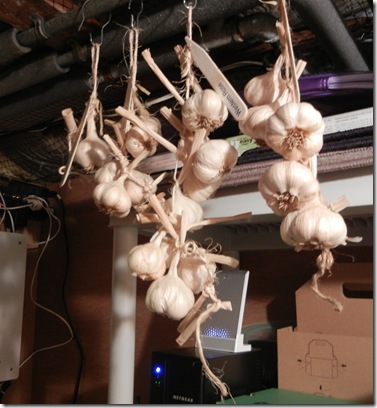
Since that room is visited frequently, I was keeping an eye on the state of the bulbs and have been happy with how they’ve been keeping. Lately, however, I’ve noticed the outer skins on some of the bulbs I’ve brought up to cook with have been more dry and looser. Also, some bulbs are showing sprouting cloves. They’ve got nowhere to grow at this point and are still safe to cook, but I decided that just in case I’d process and freeze some of them. I selected the remaining five bulbs of ‘Tai Lang’ for this project. Incidentally, I’ve found nothing about this cultivar online; Googling it just brings up my own references to growing it. All I know is I bought it at the Westside Community Market and the seller said it was hot.

The first step in processing garlic for freezing is to peel each individual clove. When I’m doing one or two or five for a recipe I just cut off the root end, halve it lengthwise and then flake away the skin with a knife. To peel quantities of garlic I use a faster method. First, separate all the cloves in the bulb and cut off  the root end. Then, lightly crush them with the flat of your knife. Be careful. You’ll end up with a chaotic pile of garlic cloves and papery skins.

Next, get a couple of bowls, preferably stainless steel, that are close to the same size. In a pinch, you can just use a bowl and a plate.  Put your distressed garlic cloves in the bowls and get ready to rumble!

Cover one bowl with the other and sha-a-a-ake vigorously. Listen to the tone and you can actually hear when the cloves have been removed from the skins. It’s pretty cool and I’m sure there’s some big-ass industrial machine out there that uses the same principle to do the same thing. Now you just pick the oh-so-tasty garlic cloves out of the skins and set them aside.

Next, chop the garlic to make it easier to dispense and use. Either coarsely chop it by hand if you have the time and patience. I didn’t so I used a mini food processor. Don’t overdo it. If you want a finer chop later you can always do it then.

The final step is to get some protection on those chopped cloves. Drizzle in a little olive oil and stir it into the chopped garlic. A little goes a long way! The key is to coat the cloves without having them swimming in it. Stir thoroughly so that they’re completely coated. The oil will keep the garlic from turning ugly colors and also make it easier to spoon out the quantity you need when cookin’ time comes around.

Finally, put the oiled garlic in a jar and screw that lid on tightly. Keep it in the freezer and just scoop out however much you need in your future cooking. You’ll thank yourself for putting in the effort now not only for saving yourself the chopping later, but for also saving some produce that may not have lasted until the next crop comes ready.How do you keep your garlic? I’d be interested in hearing new ideas on growing and storing one of my favorite crops. Comment or email to share your ideas.

This riveting, stem-grinding offering is part of Post Produce, hosted by Daniel Gasteiger over at Your Small Kitchen Garden. Check it out!

Monday, September 26, 2011

Roasting Peppers -- I've Figured It Out

This year the only pepper seeds I started for planting in the garden were for an heirloom variety called Chervena Chushka. The plants turned out to be prolific producers and I was able to harvest a good number for roasting.


In the past my attempts at roasting peppers haven't been entirely successful. The idea is to char the skin so that it rubs off cleanly and easily and in the process the flesh of the pepper is rendered soft, sweet and delicious. The method I previously used consisted of taking the grid off one of the gas burners and laying/holding the pepper directly in the flame. When I tried that this time, I got the same results I always have. The skin blistered, blackened and peeled readily on the bulges of the pepper but stayed fresh and undercooked in the valleys, so to speak. I got frustrated with this process and decided to try the broiler method. I arranged the peppers on a baking sheet and positioned them as close to the broiler element as the oven rack allowed and watched closely as the wider parts began to blister and char while the tips remained red and fresh this time. This wasn't any better than the flame. Deciding that at least on the stovetop I could tediously direct the flame at the spots that obviously still needed it, I pulled the peppers from the oven. That's when the discovery happened. Now that the peppers had been pre-roasted or at least had the chill taken off them, they blistered and charred quickly and evenly in the gas flame.


After each pepper was completely roasted I placed it in a pan covered with foil to allow them to steam a little longer and loosen the skin.


After they'd all been roasted and rested, the skins slipped off ridiculously easily revealing the sweet, fragrant flesh.


In the end we stuffed them with polenta and goat cheese and served them with some nice roasted halibut and Tasty Evergreen and Sungold tomatoes also from the garden.

Thursday, September 1, 2011

Curry and Connections

Tonight I made a decent Kerala style mushroom curry. I found the recipe via an online friend I first met via an orchid discussion forum. She lives in Mumbai and has an excellent blog of her own that you should check out some time. Something struck me about the fact that when I was looking for advice about authentic Indian cuisine, I was able to get authoritative input from someone I've talked with for years but have never met. Such is the power of the Internet.


Occasionally I'll step back from the keyboard and take a critical look at the role the Internet plays in my life. I recently returned from a wonderful camping vacation where I probably could have but didn't bother to access the Web, email, etc. I really didn't miss them. Sure, I was capturing images I may post on facebook at some point and, yes, I did manage to do one ambient sound recording that may find its way onto Freesound. (It stars a vireo with wolf backup, by the way.) I had plenty of treeware, an ereader and my precious notebooks to keep me busy and I knew I'd be back online soon after returning to civilization.

Best of all I had the opportunity to let my mind slow down and really evaluate how I spend my time, including my Internet usage, and I decided it's a valuable connection to the people and information that enrich my life. I think about the individual and joint projects I've got simmering right now and while it can seem overwhelming at times, they're things I truly enjoy or that I feel are important. While I was jotting down yet another URL in my notebook to check out when I got home I looked at my to-do list. It occurred to me that I really need a to-don't list. It doesn't even have one item on it yet, but I'm getting close to formulating the first one. It goes along the line of "Don't waste time/energy on things you don't really care about." Simple enough, but I have a feeling there's some power in it I haven't quite yet realized.

Meanwhile, the curry was good but it was also a learning experience--what experience isn't? The recipe I used was from one of the sites Sunita recommended, a blog called Vazhayila. I used a mixture of the oyster mushrooms from the almost-neighborhood farmers market and some regular button mushrooms. The onion, garlic, jalapeno and tomato came from our own garden. Spices were from our local Penzey's store. The co-conspirator told me--after the fact--that Penzey's chili powder is a bit on the strong side. That and the extra jalapeno I added were evident when we were sweating and sniffling our way through dinner. A few dollops of yogurt helped cool things down. Next time I'll remember to make a cucumber raita. Finally, local tortillas stood in for the chapatis since I thought we were out of whole wheat flour and I didn't want to venture out into traffic again.

Monday, July 25, 2011

A Day on the Farm

Yesterday we had the pleasure of visiting the source of one of our Farmers' Market staples. When we learned that REAP Food Group was having a "Day on the Farm" event at Dreamfarm, just outside of Cross Plains, we signed up right away. Dreamfarm, which is operated by Diana and Jim Murphy and their family produces several delicious goat cheeses we buy all through the season. They also sell eggs from the hens they raise on their twenty-five acre organic farm.

All of their chickens are kept outside on pasture. At night they move into white hoop houses that have laying boxes in them. They're allowed to scratch and feed and cluck contentedly until the area starts to show some wear and then the hoop house and fence are moved to the next area to allow the previous one to regenerate before being grazed again.

The Murphys have several breeds of chickens, one of which is the Bovan which they get from an Amish supplier in my home town. They're a reddish brown color and are reportedly good egg producers. I think they're just beautiful. When it comes time for us to get some chickens, it's going to be hard to choose among the various breeds available.

A little farther down the valley from the chicken pastures is a group of beehives. These aren't the Murphy's. They belong to someone else who is keeping them on their land. Jim said he might get bees of his own some day, but only to produce honey for himself and not for the market.


Back up the hill we met, to me, the real stars of the farm livestock. Right now they are milking twenty-four goats to produce their cheeses. The herd is a mix of breeds--Jim mentioned Nubians and Alpines but I missed the rest. They're bred yearly and the kids are mostly sold, although it sounds like they may try to increase their pasture space to keep more of them in the future.

Right next door is a small flock of Jacob's sheep. This is an ancient breed they keep to preserve the genetic stock. The spotted fleeces are used to produce a range of colors. A spinner/knitter demonstrating on the farm told me she sorts the colors to produce different colored yarns. Look at all those horns!

After viewing all this livestock, it was time for lunch! The meal was prepared by several Madison restaurants. It included a fresh green salad with summer squash, a beet salad with peas, green beans and dill, chicken shawarma, lamb kofta, hummus, tabouleh, and kind of a "heap o' gyro" with goat meat from the farm. I washed it down with a cold glass of rhubarb lemonade, something I've got to try making myself.

Just as I was saying it would be nice to have something sweet to follow up that hearty, spicy lunch we happened on the tent where they were serving goat milk gelato! We each got a scoop of plain and one of cajeta which is a cooked, carmelized goat milk essentially like dulce de leche. Fresh local berries, a sprinkle of granola and a drizzle of honey topped it all off. It. Was. Fantastic!

Sweet tooth satisfied we then joined the first of the formal tours of the farm. The tour started with a visit to the cheesery. Diana ran us through the process of how she makes her different cheeses. It's a painstaking process that requires a lot of skill and knowledge. She told us how the pasteurizer works and the differences in how the fresh and aged cheeses are made. It's all hand work and lots of it. Several years ago we attended the premier of a documentary film called "Living on the Wedge." It's about artisan cheesemakers in Wisconsin. I remember Diana making an appearance in the film just when she was working on the intern stage, I believe, of her cheesemaking education. It's so awesome now to see her producing and marketing such superior products on her own farm.

Visiting Dreamfarm reminded me how easy it is to get caught up in romantic fantasies about what country living is. The bucolic scenery and serene livestock can lull you into believing just shucking off the city life and retreating to "a place in the country," as the Co-Conspirator and I now refer to our hypothetical destination, will lead only to restful satisfaction. But we really do know better. I only had to get a whiff of the air in one of those chicken houses to be transported back to my younger days hauling water and feed to a flock of chickens. Farming is hard, endless work. My hope is that in the easygoing events of the day the message still gets through and that the guests to the farm appreciated what goes into what the farm produces. Bon appetit and thank a farmer.

Wednesday, July 20, 2011

A Quick Garden Update

With temperatures approaching those found on the surface of the sun and humidity in excess of 150% we haven't been spending a lot of time in the garden this week. Still, an occasional visit is necessary to make sure everything's OK and to pick the beans so that they keep producing more than we can eat. We tell ourselves we'll freeze some and eventually we will. We're currently only picking the Pencil Pod (yellow) and Royal Burgundy (purple) bush beans. The rest of the beans are being grown on to the shell or dried stage. I harvested both yesterday.


All the while I was doing it the resident hawk was all, like "OMG! You're picking beans! That is so cool!!!"


I also checked how the other crops were coming along, especially the tomatoes and peppers. I picked a couple more really ripe Sungold cherry tomatoes that went straight into dinner's salad. There are a bunch more that will be coming on soon.


The larger varieties are holding a lot of fruit right now that just needs to start turning red, except of course for the Tasty Evergreen that never will. I wonder how I'll know they're ripe. Here are either some Carbon or Italian Heirloom. I forget which.


In the pepper department the first poblano is starting to get some color on it.


It's going to be dark and tasty while the Jimmy Nardello's Sweet Italian Frying Pepper near it is turning an inviting bright red.


A good bunch of Early Jalpenos are forming, too.


On the way out of the garden I passed one of the community fruit trees. It'll be interesting to see if the fruit is allowed to ripen. One of the drawbacks of community gardens is that there is pretty intense competition for shared resources. I don't even bother looking over the shared raspberry plants anymore. People are so anxious to get them before someone else does that the majority of them are picked when they just start to turn color. For the time being, the little pears are pretty and I can enjoy them at this stage just hanging on the trees.

Tuesday, July 12, 2011

A Little Appetizer


Sunday was oppressively hot so naturally I decided to go the the garden and take care of a few tasks. I'd been reading up on when to harvest garlic since our plants were showing signs of slowing down. Bottom leaves were browning and drying up as were the tips of most of the rest of the leaves. I decided to take a chance and harvest the whole crop. I'd dug a couple of bulbs over the past week or so and they seemed ok. In the end, counting the two early harvests we ended up with forty-three bulbs from the forty cloves we planted. I think that's a pretty good success rate. The three double bulbs were all the same variety.

In the process of digging them up, I nicked one of the bulbs. Since it wouldn't keep for long in its damaged condition, I went ahead and roasted it in a little olive oil. The resulting, sweet/savory paste inspired me to make a little appetizer that ended up comprising most of my dinner. I toasted a couple slices of some grainy bread from Clasen's which I then further browned in a pan with some olive oil. Honestly, Clasen's makes some decent pastries, but their country style breads really are the Wonder Bread of artisanal loaves. But, they were two for the price of one so how could I pass that up? Additional heat helps.

I plucked some basil from the pot on the deck and sliced up a tomato from Flyte Family Farm. After spreading the lucious garlic paste on the bread I layed on the tomato slices, sprinkled with some basil ribbons and hit with another drizzle of olive oil. The bread was still too soft, but on the other hand it didn't shatter and send the toppings flying. I would definitely make this again but with a heartier bread.

Wednesday, July 6, 2011

Tapas Night!

When no specific dinner plan is in mind and the time to dine draws near, a familiar call is heard throughout the neighborhood--"Tapas Night!" Tapas Night is our cop-out excuse for throwing together leftovers on little plates. No, wait, I take take that back. At one time that might have been true, but I dare say the co-conspirator and I have evolved as cooks and, frankly, Tapas Night has become an opportunity to try out new tastes and small bites from whatever the fridge, pantry and garden present us. Tonight's was no New Year's Eve, but it was still pretty special.

After work I went up to the garden to take care of a few things and brought home a bit of the produce. When I got home we talked about dinner, a dish I had an idea for, and the fact that we really didn't have much of a plan beyond that. Activate Tapas Night. Sorry about the pictures, though. I was more into cooking than paying attention to lighting so most of these suck. I'm not a food stylist so if you have any suggestions on the light and color problems I'd be more than glad to hear them.

The dish I had planned on making was a chilled fava bean and pea soup inspired by our visit last weekend to Nostrano. My recipe was not much like theirs, but I think it showcased the flavor of the legumes. I started with the beans I had previously shelled plus the ones I picked tonight by giving them a long blanch in salted water. They then popped easily out of their skins and into a mason jar.


"Why a mason jar?" you may ask. I shall tell you. We learned recently that the base doohicky on our blender is threaded to match such jars and so is handy for making small batches of things like salad dressings and soups. Cool!


The favas were pureed with some peas (some from the garden, some from the freezer), mint, yogurt, salt and water. The result was delicious! The bean flavor was at the forefront. I served it in my grandmother's coffee cups. More on those at a later date.


Meanwhile, on another stretch of the kitchen counter the co-conspirator was whipping up something with little potatoes left over from the Fourth's potato salad and some cherry tomatoes from the Westside Community Market.

The par-boiled taters were given a quick roast in the toaster oven...


...while a tomato sauce was simmering on the stove.


The sauce (based on a recipe in The New Spanish Table) had a nice smoky note from the smoked paprika. We could have used some more potatoes!


Meanwhile, some less-than-baby carrots were waiting. After pruning and tying up the tomatoes, picking the favas and watering the cukes, I thinned the carrots--a task I'd forgotten to do for too long. Consequently I had a handful of carrots that were too big to throw away and just right for a simple small plate creation.


I lightly steamed them with some fresh chervil I'd picked on the outside chance we'd need it for dinner. Incidentally, I steamed them with some of the already hot water I'd used to blanch the fava beans. It had turned red! What's up with that?


Served with a pinch of sea salt smoked over Welsh oak, they were delicious. The marked difference in flavor between the orange carrots and the yellow carrots made me wonder why anyone would bother to grow the latter, which were part of a gimmicky "rainbow carrots" seed blend.


Meanwhile the zenith of our Tapas Night feast was being prepared on the sidelines. Half of our sweet basil plants have decided to be anemic, pathetic wastes of chlorophyll. The rest, on the other hand, are growing like kudzu and threatening to flower. I reined them in by harvesting a respectable number of stems this evening. Call us unimaginative, but pesto is the first thing that came to mind.


But what to pair it with? Pasta was suggested but quickly abandoned. Why not just sauce it on some sauteed shrimp? OK. Sounds good. Better than good.


The result was a perfect blend of the sweet seafoodiness of the shrimp and the savory, herbal contribution of the basil.


Now that we're in what I like to call "High Summer" here I'm looking forward to more spontaneous, experimental cooking events. The volume and variety of fresh ingredients that are available now is inspiring. Sometimes we like to put together a more normal main dish/side dish/salad dinner and that's fine. But when we've got the time, energy, ingredients and ideas it's way fun to just go with what we've got and savor the results.